We use decades of academic research and data to validate what we know is true today, rather than making forecasts about what might happen tomorrow. By sticking to these proven insights, we follow a clear set of rules the exact same way every time. This eliminates human bias and emotion, creating a strictly repeatable system.
Decisions are grounded in long run data and research, not opinions about what the market might do tomorrow.
A fixed set of rules is applied consistently. The portfolio is rebalanced six times a year, the same disciplined way.
Around 100 to 130 stocks spread across all 11 industry sectors, sized by market value and liquidity to manage risk.
We stick to a strict, repeatable framework so the investing experience stays simple. What matters is the objective: a high franked income, paid quarterly, from a portfolio that is diversified and built to grow.
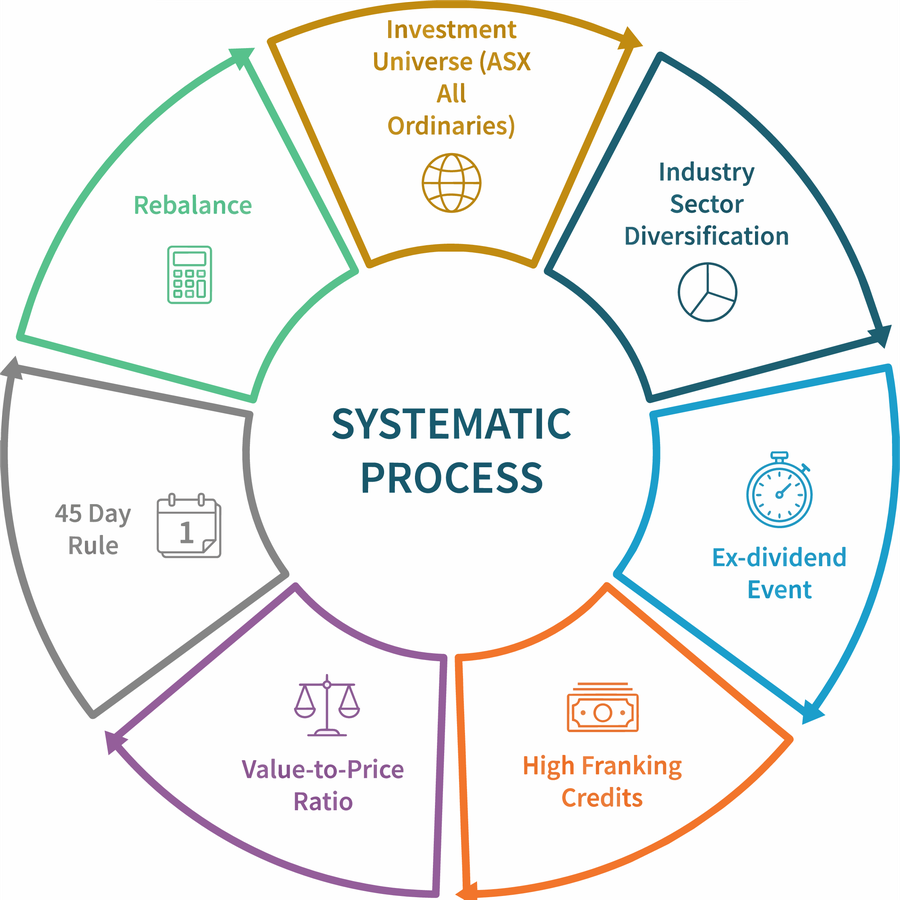
The portfolio is built by a systematic process with seven stages. Stocks are drawn from the investment universe of the ASX All Ordinaries, diversified across all 11 FTSE ICB industry sectors. Selection then follows the income signals: upcoming ex-dividend events, projected high franking credits, each stock's value-to-price ratio, and the 45 day rule that preserves franking credit eligibility. The portfolio then rebalances, and the cycle begins again.
Weights account for market capitalisation and liquidity, and portfolio rules keep the Fund diversified at every stage.
The published evidence shows many active managers underperform their benchmarks over time, while passive index funds are typically not designed around after-tax outcomes. Evidence based, systematic investing combines the discipline of rules with a focus on what investors keep after tax.